
Pucker Technique for a U-Blocker

Originally posted Nov 2013

ublock-pucker-300x112This blog post is adapted from an email exchange with Tony, a reader who U-blocks but would like to get better at the pucker technique, because it frees the tongue for playing articulations and bending.

U-Blocking
If you haven’t heard of it before, U-blocking is a single-note embouchure that isolates a hole by rolling the sides of the tongue up into a U. The lips rest on the coverplates, and the rolled-up tongue touches the harp and is moved side to side as you play. It’s a technique that has the advantage of reducing head and hand movement. Some players also find that U-blocking helps them with blow bends, especially on hole 10.

Pucker Advantages
I feel the pucker has a distinct advantage for bending notes, because the tongue is free to adjust its position. Yes, you can bend when U-blocking or using traditional tongue-blocking, but the tongue has to adjust its shape while remaining in contact with the harp. Also, with the pucker, you don’t have to adjust your embouchure for playing articulations – you just say “Ta Ta” or “TikKa Tikka” and carry on playing, because your tongue is free. I’ll note that tongue blockers can make the same argument for seamlessly adding octaves, tongue slaps and chords, but I’m extolling the virtues of the pucker right now, so let’s stay on task…

Adjusting to a New Embouchure
If you’re a U-blocker and want to learn the pucker technique, I’d recommend practicing really simple exercises and songs mindfully – take it slow, notice when you start to U-block, and reset to the pucker. It might take a little time, but just be patient. The major scale from 4-7 is a good place to start.

4 -4 5 -5 6 -6 -7 7

7 -7 -6 6 -5 5 -4 4

This advice is the same for any new embouchure, by the way, whether you’re a U-blocker learning to pucker, or a pucker player learning to tongue-block.

Single notes are the key. If you practice playing clean single notes consistently using U-Blocking, Pucker, or Tongue Blocking, you’ll have more success bending, regardless of your embouchure.

Have patience, and take your time! You’ll get there.
A Note About “Timber”

Originally posted Nov 2013

A reader wrote in to request the harmonica part from “Timber,” the new single from Pitbull, featuring Kesha.

I hadn’t heard it yet, so I looked it up and threw together a little tutorial. It’s a short part, but it gets looped throughout the song, and it’s kinda neat to hear harmonica used in a current Top 40 song, doncha think?

Digging a little deeper, I found that the harp appears to have been played by Lee Oskar, the legendary member of the 70s Latin / Funk band WAR, and maker of Lee Oskar harmonicas. Way to go, Lee!

Knowing Lee’s style somewhat, there’s a good chance he’s playing an alternate-tuned harmonica, but I worked it out on a standard instrument, and I think it sounds pretty good.

Edit: Nov 18 – I’ve added a full video lesson at the Timber tab page, focusing on the lower octave version that requires bends, since it’s closer to the recorded performance on the Pitbull/Kesha track. For my tab transcription, plus a video demonstration, click here.

Tongue Articulations

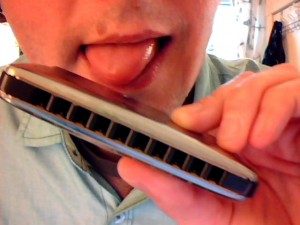
tongue_articulations-300x225A reader asks, “Do harmonica players use their tongues?”
Yes! Here are a few uses of tongue articulations:

– punching certain notes harder
– articulating repeated notes
– drumming out chord rhythms

TA and KA

You have two main options for articulating notes with your tongue.

Say TA with front of tongue
Say KA with middle/back of tongue

These articulations happen INSIDE the mouth, behind the teeth, without touching the harp.

Legato vs. Staccato

It’s worth noting that you don’t have to use your tongue to articulate every note you play. Most of the time, I try to play in a smooth, flowing “legato” style: with no special articulation, just sliding sideways to the next note or changing breath direction. Tongue articulation adds a clipped, percussive, “staccato” effect. I use it a lot for chordal rhythm work, and occasionally for a rhythmic effect on single notes.

Tongue for Clear Single Notes?

Another tongue technique is “tongue blocking,” where you use the tongue to block out 2-3 holes on the left while you play out of the right corner of your mouth. That’s a whole other discussion, but TB is another super common tongue technique.

In my own playing, I tend to isolate notes by putting the harp deep in my mouth and using the inside of my pucker to zero in on the hole.

Conclusion

Saying TA TA TA TA or TAKA TAKA TAKA is an easy way to play complex, percussive rhythms. Tongue articulations also seem to help when you need to land directly on a bent note on 2 or 3 draw. Practice playing legato, without articulations, and staccato, with articulations.

The Train

Harmonica players sometimes use glottal stops as an articulation, but I think it’s more useful for beginners to focus on keeping the throat open and relaxed while breathing from the diaphragm.

To help with this, I recommend learning to play The Train, a common old-timey blues exercise:

Big relaxed mouth, playing the 3 holes on the low end: that’s holes 1,2,3

Long IN breath
Long OUT breath
Long IN breath
Long OUT breath

Now put a little pause in the middle of each breath.

IN IN
OUT OUT
IN IN
OUT OUT

Repeat steadily.

Keep throat relaxed and open, feel the breath in your belly.

The goal is to remain relaxed while breathing rhythmically, whether you’re going slow, medium, or fast.

If throat still closes up unintentionally, play long notes: IN…….OUT and repeat until relaxed.

Quick Beatbox Harmonica Lesson

A reader recently requested “My Shoes,” a song by Jeremy Loops, a musical artist from Cape Town, South Africa, and I had some time today, so I dashed off a sketch of the beatbox harmonica intro.

The groove presented here will work as a quick introduction to making percussive sounds while chugging on chords. I even filmed a Youtube video to demonstrate!

Click here for my Jeremy Loops Beatbox Harmonica Lesson.

Alternate Tunings For Beginners

Here’s a sketch of several harmonica tunings I’ve messed around with.

Bends a Bonus, But Not Required – You can dive right into these first three tunings without any bending skill. If you can bend already, it’s always handy, but these tunings are particularly good for beginners.

Spiral / Circular – takes you straight up the diatonic major scale, no missing notes, draw is always higher than blow, and all bends are only a half-step. Two popular variations place the tonic note on 1 blow or 2 draw. Great for diatonic melodies, improvising, and fiddle tunes. Also has beautiful chords, can be folky or jazzy for rhythm work. If you’re crazy, you can use any scale as the basis for a spiral tuning: minor, harmonic minor, whole tone…the mind boggles.

Paddy Richter – just a plain ol’ diatonic harp with the 3 blow tuned up a whole step. Gives you the 6th scale degree in 1st position without having to bend. Great for pentatonic melodies, especially Irish fiddle tunes. Provides a nice minor chord starting on the 3 blow. Popularized/invented by Brendan Power.

Easy Third – 2 and 3 draw are tuned down a whole step. Gives you a giant minor draw chord with roots on the 1 and 4 draw. “Easy Third” refers to the ease with which this tuning plays 3rd position minor tunes, esp in low octave. Good for Dorian minor tunes that omit the major 7th. Also awesome for tongue blocking chords whilst playing minor melodies.

Bending is a Must – these next three tunings require skill at bending in the low octave…

PowerBender – normal layout from 1-4, then different from 5-10. Consistent breath pattern: all draws higher than blows, so lots of draw bends, hence “PowerBender.” Particularly cool in 2nd Position, allowing you to move low octave blues riffs up high to the next octave with basically no change in technique. Another Brendan Power tuning.

Dorian – 3 and 7 draw tuned down a 1/2 step, so you get Dorian Minor in Second Position. You could also call this the Mixolydian Tuning, because 1st position gives you a major scale with a minor 7th.

Natural Minor – gives you a minor chord on the draw and also on the blow. I’m mainly interested in this for rhythm work, but there’s no reason one couldn’t get great use out of it for natural minor melodies.

Tongue Blocking

And then there’s this neat one that requires tongue blocking…

Bagpipe Tuning – as used by James Conway, you tune the 1 draw down so it matches the blow, and tune the 2 blow up so it matches the 2 draw. 3 and 7 draw come down a half step. The end effect is a really primal sounding tonic chord on the blow AND draw, allowing you to tongue block and keep a constant drone out of the left side of your mouth, regardless of breath direction, while playing modal melodies on the right side.

Simplicity vs. “The Right Tool For the Job”
Why fool around with any of this? Well, every tuning has something it does particularly well, and why not use the “right tool for the job?” I spent a year or two experimenting with alternate tunings and found that I played fiddle tunes MUCH more cleanly using Paddy Richter, for instance. I eventually found my way back to standard tuning, out of a desire to have a single set of techniques and scale patterns for all my music. But I can really see the appeal of alternate tunings for specialized purposes. Spiral works brilliantly for melodies and improv, and is so intuitive. It probably ought to be everyone’s first harmonica. Natural Minor is so strong for chord vamping, especially in reggae songs. And cross harp fanatics can get EVEN MORE CROSS HARP out of a PowerBender. Why not? Give some of these a try. Diatonic harps aren’t THAT expensive. Or, if you’re of a technical bent, use an old harp and tune one up yourself with files, poster putty, or reed replacement.

PowerBender 2nd Position

Scale tab patterns are at the bottom…

2nd Position in PowerBender Tuning
Have you heard the harmonica players chanting in the streets? “We want expressive draw bends in 2nd Position, all the way up the harp!” PowerBender gives you those bends, plus an ice skating rink full of glissando possibilities.

Do I use 4 draw or 5 blow?
In PowerBender tuning, the 4 draw note is the same as the 5 blow note. I use 4 draw on the Blues Scale, since a bend is required for the “blue note.” The Minor Pentatonic doesn’t include that note, so I suggest using the 5 blow there. Those are the best first options, I think, but it’s worth working out two versions of each scale so you’ll have the most flexibility when moving around.

Glissandos
Because of the doubling of the 4 draw and 5 blow notes, you’ll notice some really interesting spots in certain scales, where you get to play multiple notes in a row in the same breath direction. Just slide back and forth on the scale. Woohoo! Check out the blow notes in the middle of the Minor Pentatonic, and the draw notes in the middle of the Major Pentatonic. Major speed zones, potentially. Think John Popper or Jason Ricci.

Bonus Notes
Each of the scales noted here covers 2 full octaves, with additional stray notes left at the top and bottom ends. I call these extras “bonus notes.”

Gratuitous Bending
Remember, in PowerBender tuning, all the draw notes can be bent. So anytime a draw note is indicated in one of these scales, try bending up to it and see if doing so adds expressiveness or if it’s just weird-sounding.

Blues Scale

-2 -3′ 4 -4′ -4 6 -6

-6 -7′ 8 -8′ -8 -9″ -9

bonus notes: -9 -10″ -10
and -2 -2″ -1 1

Minor Pentatonic Scale

-2 -3′ 4 5 6 -6

-6 -7′ 8 -8 -9″ -9

bonus notes: -9 -10″ -10
and -2 -2″ -1 1

Major Pentatonic Scale

-2 -3″ -3 -4 -5 -6

-6 7 -7 -8 9 -9

bonus notes: -9 10 -10′
and -2 2 -1

Major Scale

-2 -3″ -3 4 -4 -5 -6′ -6

-6 7 -7 8 -8 9 -9′ -9

bonus notes: -9 10 -10′
and -2 -2′ 2 -1 1

Holy Cow, This is Amazing
Let’s take a moment now to note how cool it is that PowerBender tuning allows you to play a full major scale in 2nd position, across TWO OCTAVES, with all the bluesy bend possibilities on important chord tones? Thank you, Brendan Power.

(What’s that, you say? You could do that in standard tuning on a Suzuki SUB30? Well then, thanks again to Mr. Power.)

Tuning with Poster Putty

Introduction

Want to try out an altered tuning but hate using a file?

I’ve had a lot of fun lately using poster putty (known outside the US as “Blu-Tac”) to drop the pitch of reeds and experiment with alternate tunings. Here’s the really neat part: if you don’t like the results, unstick the putty and you’re back to normal. No harm done; it’s completely reversible. Brendan Power pioneered this technique years ago, and I either heard about it from him or from Pat Missin. There’s also been a good amount of discussion of tuning harmonicas using putty / Blu Tac on Harp-L and the ModernBluesHarmonica forum.

Dorian Tuning
One of the easiest tunings to attempt is “Dorian,” which turns 2nd position cross harp from major to minor. While Dorian Tuning is usually thought of as a really easy way to get jazzy sounds in a familiar position, it also turns 1st position into Mixolydian, which is a neat modal major sound for Celtic music. But I digress.

Just change two notes: drop the 3 and 7 draw by a 1/2 step.

Because these are both draw notes, they’re accessible on the outside of the reedplate, which means you don’t have to fully disassemble the harp to retune them.

On a C harp, the 3 and 7 draw will be a B. You’ll retune them both to B-flat. If you use a different key harmonica, just make your target pitch for 3 and 7 draw a half-step lower than the original note.

Let’s get started!

Supplies you’ll need:

1. Poster Putty or Blu-Tac ($5 at office supply store)
2. X-acto style craft knife
3. C Harmonica
4. Chromatic Electronic Tuner
5. Paper receipt or other thin shim
6. Small Screwdriver

Prepare the harp:

1. Remove cover plates of harmonica
2. Turn harp over, so draw reeds are visible.
3. Insert paper or shim gently under the 3 draw reed

Prepare the putty:

1. Cut off a TINY corner with your Xacto knife.
2. Roll it on the table until it’s a TINY thin tube.
3. Cut off a TINY piece of that thin tube.

Did I mention you’ll only need a TINY amount of putty? You’ll get a feel for how much is enough after you’ve experimented a bit, but generally, start with less than you might think you’d need.

Tuning:

1. Make sure the 3 draw reed is supported by the shim. Use the Xacto blade to place a tiny piece of putty on the free, weighted end of the Draw 3 reed. Press the putty gently so it sticks to the reed.

2. Use the Xacto blade to shape the putty so it doesn’t squish out beyond the edge of the reed. That’ll ensure the reed swings freely without catching in the slot.

3. Remove the shim and play the 3 draw. Your tuner will tell you if you’ve made it to the target note.

Fine Tuning:

1. Lower Pitch: If you’re too high and need to lower the pitch further, cut off another TINY piece of putty from the tube you rolled out, and stick it on top of what you’ve added so far. Use the knife blade to shape the putty so it doesn’t squish beyond the edge of the reed.

2. Raise Pitch: If you’re too low and need to raise the pitch a little, remove the putty, cut off a TINY bit from it, and reapply.

3. You can also adjust the pitch moving the putty closer or farther from the free end. Closer to the free end lowers the pitch, farther from the free end raises it.

4. Smaller reeds require less putty.

Repeat this process until 3 and 7 draw are tuned a half-step lower. That’s B-flat, if you’re starting with a B.

Afterward
Have fun with your new, custom-tuned harmonica, and rest easy, knowing it’s reversible! To get back to standard tuning, just remove the putty and you’re home free. Or leave it on! If the reeds are dry to start with, the putty seems to stay put pretty well. If a piece gets unstuck, disassemble, find the rogue blob inside the comb or coverplate and reapply, or use a new tiny piece of putty.

Exhilarated by this new world of altered harmonica tunings? Check out Pat Missin’s great guide, titled “Altered States

An Afternoon Playing Jazz Diatonic Harmonica

Originally posted June 2013

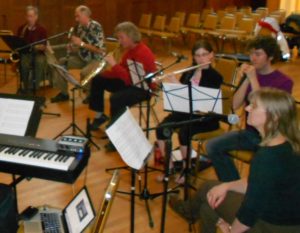
pboro_jazz_workshopI had the opportunity to play harmonica in a jazz workshop the other weekend in Peterborough, NH at the Monadnock Center for History and Culture. I brought a mic and 14 harps with me, in various keys, but ended up only playing my C diatonic Golden Melody.

I settled on the C harp, not because the key was particularly suited to the tunes called for that day, but because it it has the best overblow setup of my current harps, and importantly, it’s the one I read best on.

We played Solar, by Miles Davis, So Danco Samba by Jobim, a Mingus tune arranged in 5, and a ballad whose name I forget.

We read the tunes down, everybody took a solo, and the director gave us suggestions, one of which was to play guide tones behind the soloists during B sections, then remember those guide tones to help structure our own solos.

The high school flautist sitting next to me had an even simpler approach: take the notes in each measure and rearrange them. Brilliant.

In my solos, I ended up mostly just arpeggiating chords. But darned if that didn’t get me through the changes and sound a little bit like I knew what was going on!

My intonation in the low octave was sometimes a little seasick, but the fact that I got through all keys and chords without much problem was a major encouragement. Next step is to get through those changes with more linear lines and less hopping…

It was really great to play with a live jazz rhythm section and be a part of a horn section for a couple hours.

Big thanks to workshop leader Rich Greenblatt and to Gordon Peery for organizing this event at the Monadnock Center for History and Culture.

So This One Time, At Harmonica Camp…

Originally posted May 2013

Davie - Dreis - Conway

At the end of April 2013 I flew to Indianapolis for a multi-day event organized by Jason Ricci and Winslow Yerxa called “Harmonica Collective.”

It was a blast. After an opening night jam at a local blues bar, we had three days of classes on improv, theory, breathing, tongue blocking, amplification, mic technique, and how to tweak harmonicas for better playability.

At the end, we closed out back at the blues bar with a staff concert, during which I was called up to perform with two of my teachers, Paul Davies and James Conway.

Paul and I played an improvised waltz as a duo, then James brought out his bagpipe-tuned harp for a solo piece, and we finished with an uptempo trio take on the Harvest Home Hornpipe.

I’m still processing all the class material, one-to-one conversations, and jam experiences. It was nice to meet so many people with their own harmonica obsessions.

I came away from Harmonica Collective with a renewed focus on tongue blocking, especially corner switching for fiddle tunes with big leaps.

Also, I quickly realized that most of the players there had played a lot more blues jams than me. I spend a lot of time woodshedding fiddle tunes and taking melodies through all 12 positions. It might be time to take a step back and just groove in cross harp awhile.

Thanks to all the Expert Guides: Jason Ricci, Winslow Yerxa, Richard Sleigh, RJ Mischo, Michael Peloquin, James Conway, and Guest Stars Paul Davies and Buzz Krantz.

Also, special thanks to the Saigon Restaurant for their delicious noodle bowls and friendly home-style service. Three meals in four days! Next time, I may even order an avocado shake of my own instead of just sipping everybody else’s.