
From a Zoom harmonica lesson today, we were working on hearing and playing triplets to the beat, and also the “heartbeat,” a pattern where you have a long sound and a short sound, which is found in jigs and the blues. It’s also a demonstration of using a metronome to build your own internal sense of time : )
Category: Uncategorized
“Creep” – Radiohead harmonica jam game plan
During one of today’s Zoom harmonica lessons, a student asked about a common song at her local open mic, Radiohead’s “Creep.” Would it be possible to jump in and play harmonica on it? Yes! Here’s a game plan for the song.
Train with Horizontal Shift
In this Zoom harmonica lesson, we looked at adding a bit of movement to the Train rhythm exercise. We’re playing with a shuffle feel, and here I’m demonstrating how you can keep the groove going while varying the texture by adding higher or lower melody sounds.
Four Ways to Play to the Beat
An excerpt here from a recent lesson, looking at different rhythmic approaches to playing scales and improvising over a beat. Here, I’m demonstrating playing each note once, twice, four times, and then a “three over two” feel. As always, for personalized help, I teach Zoom harmonica lessons every week.
Playing in F on a C harp!
In a Zoom lesson this week, the student and I were looking at ways to use the bends on hole 3 and 2.
We eventually started playing “Somewhere Over the Rainbow,” starting on the 2 draw, whole step bend (-2″). It’s ended up being a good way to introduce 12th position, which means playing in the key of F on a C harp. Check out the video above to see how it works.
Why would you play in the key of F on a C harp? Well, because it’s there! But also because it’s a position that focuses on draw notes, and in the low octave that makes it expressive and soulful, since those draw notes can be bent, shaded, played with vibrato.
Also, in the middle octave (holes 4-7) it’s super clean, taking advantage of the built-in blow and draw notes, and very MAJOR sounding, as opposed to cross harp (2nd position) which is major but not in the same sweet way.
12th position potentially gives a more “Stevie Wonder” kind of sound, as compared to the more “Little Walter” sound you get in 2nd position. Obviously both of these are great musical styles, and it’s exciting to have both flavors in your toolkit.
If these kinds of distinctions sound like your cup of tea, feel free to respond and we can schedule a time to talk it through in a lesson!
Amazing Grace by Ear
In a recent Zoom harmonica lesson, we were looking at how to play Amazing Grace by ear. Why learn a tune by ear? I mean, you could just look up the tab, right? Shoot, you could even look it up right here on my website.
But you don’t always have the tab in front of you, and it’s really nice to be able to just pull out the harmonica on a walk and find a tune. I’m not really talking about memorizing the tune – I actually recommend learning to find tunes by ear.
In this video, I give you a quick outline of Amazing Grace, breaking it down into four parts, so you’ll have a few landmarks when working it out. If you take some time to try this process, it gets faster, and the next tune is easier.
And ok, ok, I used Low D, a weird harp that not everybody has. Amazing Grace is easiest to play if you aim for holes 6 – 9, which is pretty darn high on a C harp. Using a low harp makes it sound less shrill. Get a Low D! It’s great for learning fiddle tunes, and at an Irish session, it puts you in the fiddle range rather than the tin whistle range.
Want Zoom harmonica lessons? Send me an email or give me a call. Cheers!
Christmas Carols
‘Twas the night before Christmas, and I thought, “Hey, let’s remind folks about the Christmas carols posted under the letter ‘C’ on the Tabs page!”
Go play some carols: TABS
When you get there, scroll down to the letter “C” to find the Christmas songs.
Have fun, and Merry Christmas!
Fall Teaching & Two New Tabs
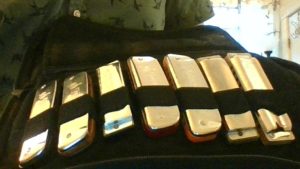 Fall Teaching, Full Swing
The school year has started for me here in New Hampshire, and along with my regular schedule of private lessons, I also lead middle school classes, organizing groups of 12-15 children to play and sing folk and pop songs using a variety of instruments. Which is to say, busy times!
Two New Folk Songs
However, I had a couple of American traditional songs on my mind during the last week, and took some time this morning to write out music for them and post them to the “Tabs” page.
“Red River Valley” is a cowboy ballad that I’ve written up in three forms: low and high octave first position and low octave second position. The three arrangements require progressively more skill: no bends, then one bend, then two bent notes.
“Skip To My Lou” was mentioned recently on a harmonica newsgroup, as a song Joe Fillisko teaches to beginner classes, so I took the hint and made my own arrangement. Sure enough, it plays great! No bent notes, and it’s a two-chord song, so it would work well as an intermediate tongue-blocking exercise to practice self-accompaniment using the 1 and 5 chords in first position.
Enjoy the tunes, and stay safe during hurricane season here in North America!
Tad
Coffee Shop Jam – June 24, 2018
I’m so proud of all the student performers this past weekend! It was a great return for the Coffee Shop Jam, this past Sunday June 24, 2018 at Local Burger in Keene, NH.
The Coffee Shop Jam is an informal performance opportunity I organize for my students, and this time around, we had 12 student performers who played guitar and ukulele. I would have loved to heard some harmonica, but student summer plans conflicted with the date. Next time!
During the show, some students performed totally solo, some played duets with me. At the end, we played a couple of big group songs.
The Coffee Shop Jam gives students an exciting (and scary) goal to work toward, and based on everybody’s feedback, a blast was had by all.
The next event isn’t scheduled yet, but I’m aiming to do it again in the fall, possible in October. Keep practicing, everybody!
Here’s the song list from last Sunday:
Crazy Train
Closing Day (original)
CM, guitar
Blitzkrieg Bop
Folsom Prison Blues
CT, ukulele
Blackbird
You’ve Got to Hide Your Love Away
WI & TD, guitar
Riptide
Ob-La-Di, Ob-La-Da
AP, ukulele
Take Me to the Water (original)
Tell Me The Future (original)
NT & TD, guitar
Make It With You
Stewball
JM & TD, guitar
Aloha ‘Oe
Coal Miner’s Daughter
Take Me Home, O Hawaii (original)
SH & TD, ukulele
Dear Prudence
JS & TD, guitar
Marry Me
Little Talks
Safe & Sound
OS & TD, guitar
Message in a Bottle
Greasy Coat
KB & TD, guitar
Daughters
LK & TD, guitar
Jambalaya
Johnny B. Goode
Everybody, guitar & ukulele
Diminished Tuning
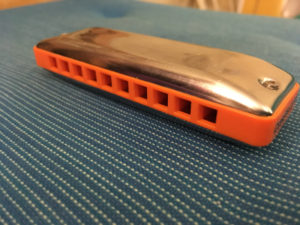 I recently got a diminished-tuned diatonic harmonica from Seydel, using their custom tuning service, and it’s really fun and logical.
The Bad News
“Wait, this harmonica doesn’t work!” If you just blow and draw, nothing sounds good. In Diminished Tuning, you have to be conscious of your scale pattern, and you’ll have to play lots of half-step bends. Also, a ten hole harp doesn’t quite cover three octaves in Diminished Tuning, so you either have to live with reduced range, or get a 12-hole model.
The Good News
In Diminished Tuning, for each scale and lick, there are only 3 breath patterns, and the only bends required are small, half-step draw bends. This approach will cover you for all 12 keys. If you’re a minimalist and only want to carry one blues harp, Diminished Tuning is extremely attractive. Especially if you love playing melodies and improv that don’t fit easily on a Richter-Tuned harp.
Moveable Shapes
The three patterns are based on the location of the tonic note: there’s one pattern that starts on the blow, one pattern that starts on the draw, and one pattern that starts on the draw bend. Playing by ear is easy, just find the tonic note and ask yourself, “Is this a blow, a draw, or a draw bend?” then play the pattern that matches.
Here are some examples, starting at Hole 1, but which can be moved to any other hole with the same relationships.
Major Pentatonic Scale
Blow Position
          _____________________
Draw Note |X|_|_|_|_|_|_|_|_|_|
Draw Bend |_|X|X|_|_|_|_|_|_|_|
Blow Note |X|_|_|X|X|_|_|_|_|_|
Draw Bend Position
          _____________________
Draw Note |_|X|X|_|_|_|_|_|_|_|
Draw Bend |X|_|_|X|X|_|_|_|_|_|
Blow Note |_|X|_|_|_|_|_|_|_|_|
Draw Position
          _____________________
Draw Note |X|_|_|X|X|_|_|_|_|_|
Draw Bend |_|X|_|_|_|_|_|_|_|_|
Blow Note |_|_|X|X|_|_|_|_|_|_|
Note Layout
Here are the notes, if you started with a C on 1 blow. Notice that every blow and draw are a whole step apart, with a half-step bend available in between. Simply by playing blow, draw-bend, draw, you get a full chromatic scale.
Draw Note  D   F   Ab   B    D   F    Ab   B    D    F
Draw Bend  Db  E   G    Bb   Db  E    G    Bb   Db   E
Blow Note  C   Eb  Gb   A    C   Eb   Gb   A    C    Eb
Hole #     1   2   3    4    5   6    7    8    9    10
Is This The End of Overblows?
Rest assured, I’m not abandoning standard Richter tuning and the overblow approach to chromaticity. Mainly because I’m used to it, but also because I like the deeper bends on holes 2, 3 and 10, I like the full three octave range on 10 holes, and I like the direct connection to the playing of great players of the past. Plus, standard tuning plays in a single primary key MUCH more easily than diminished tuning does.
But I really like the logic and ease of play of diminished tuning, especially for covering all keys and scale types on a single 10-hole blues harp. Yes, practice is required to get good intonation on the half-step draw bends, and the interval relationships from hole to hole are new.
But even after just a week, I’m confident that I actually could play a whole pop-rock gig with just one diminished harp. I’d have to keep things simple, but I think I could do it. I mean, heck, it’s just three patterns. Find the tonic note, and go!
Where to Get One?
I retuned an old Hohner Blues Harp for my first experiments, then ordered one custom tuned from Seydel, using their Harp Configurator. It cost about $80 and took about three weeks to ship from Germany. Another option would be to reach out to a domestic harmonica technician near you and request a quote for retuning.